
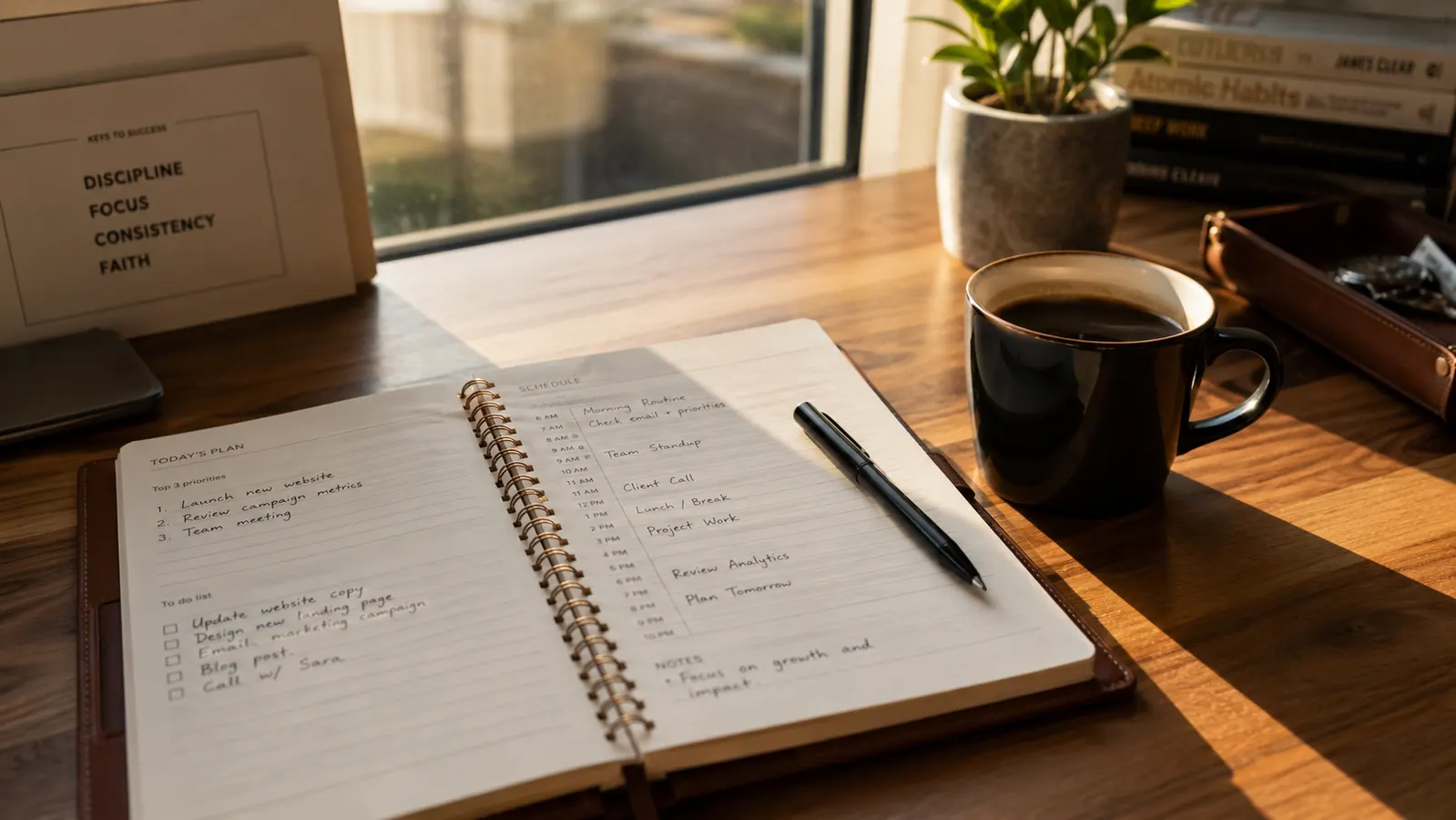
Most founders I know lose Monday before lunch. They open their laptop, the email is already in charge, and by the time they surface it is 2pm and nothing on the real list has moved. The problem is not discipline. The problem is no system. If you sit down Sunday evening with a clear structure and a physical planner, Monday looks completely different. I have run this routine for about eight months now and the single tool at the center of it is the Anecdote Daily Planner. One page per day, a 26-week undated format you can start any Sunday, and a layout that forces you to identify what actually matters before you start typing anything.
This guide walks you through five steps for building a business week that produces real output. None of it is complicated. The hard part is doing it consistently, and the planner helps with that because it creates a physical commitment that a phone app does not.
Your week is chaos because it starts without a plan. This fixes that.
The Anecdote Daily Planner gives you one structured page per day, a built-in goal and priorities section, and a 26-week undated format that starts whenever you are ready. With 5,600 ratings at 4.4 stars, it is the most-used daily planning tool on our site for a reason.
Amazon Check Today's Price on Amazon →Step 1: Do a Friday Shutdown to Clear the Slate
Weekly planning does not start Sunday. It starts Friday. Before you close your laptop for the weekend, spend 15 minutes on a shutdown ritual. Write down every open loop: unfinished tasks, unanswered emails, follow-ups you promised, projects in limbo. Get it all onto the Friday page of your planner under Notes. Then mark each item as either Done, Delegate, or Carry Forward.
The reason this works is psychological. Your brain holds open loops in working memory. If you never officially close the week, those loops keep running in the background during your weekend and you arrive Monday already fatigued. The physical act of writing them down and making a disposition decision signals to your brain that the loop is handled. Carry Forward items become your raw material for Sunday's weekly plan.
On the Anecdote planner, the Friday page has a Gratitude field and a Priorities section. I write three things that went well (keeps perspective when Fridays are rough) and then I list my Carry Forward items in the Priorities field so they are physically in the book and visible Sunday when I open it.

Step 2: Set Three Weekly Outcomes on Sunday Evening
Sunday evening, 20 minutes, no phone. Open your planner to the upcoming week. Look at your Carry Forward list from Friday and your current 90-day goals. From that input, pick three outcomes for the week. Not tasks. Outcomes. 'Call five prospects' is a task. 'Advance the Hendrix account to a signed proposal' is an outcome. The distinction matters because outcomes align your daily decisions, while tasks just keep you busy.
Write those three outcomes at the top of Sunday's page in the Goals section. Then rate each one for difficulty on a 1-to-3 scale in the margin. Anything rated 3 gets an appointment on your calendar first thing Monday morning before anything else gets scheduled. If the hardest outcome does not have a protected time block, it will not happen. This is the most reliably true thing I know about running a business.
Three is a hard limit. Founders who write ten weekly goals complete zero of them because the list has no weight. Three outcomes you can actually see on paper feel different. They create mild pressure. That pressure is useful.
Step 3: Block Deep Work Before Anything Else Gets the Time
Every Sunday, after you write your three outcomes, look at each weekday and assign one deep work block before noon. Deep work means a 90-minute window where you are making progress on one of those outcomes and nothing else is happening. No Slack, no email, no walk-in interruptions. On the Anecdote planner, I write 'DW: [outcome name]' in the time column at the top of each daily page so I see it the moment I open the book that morning.
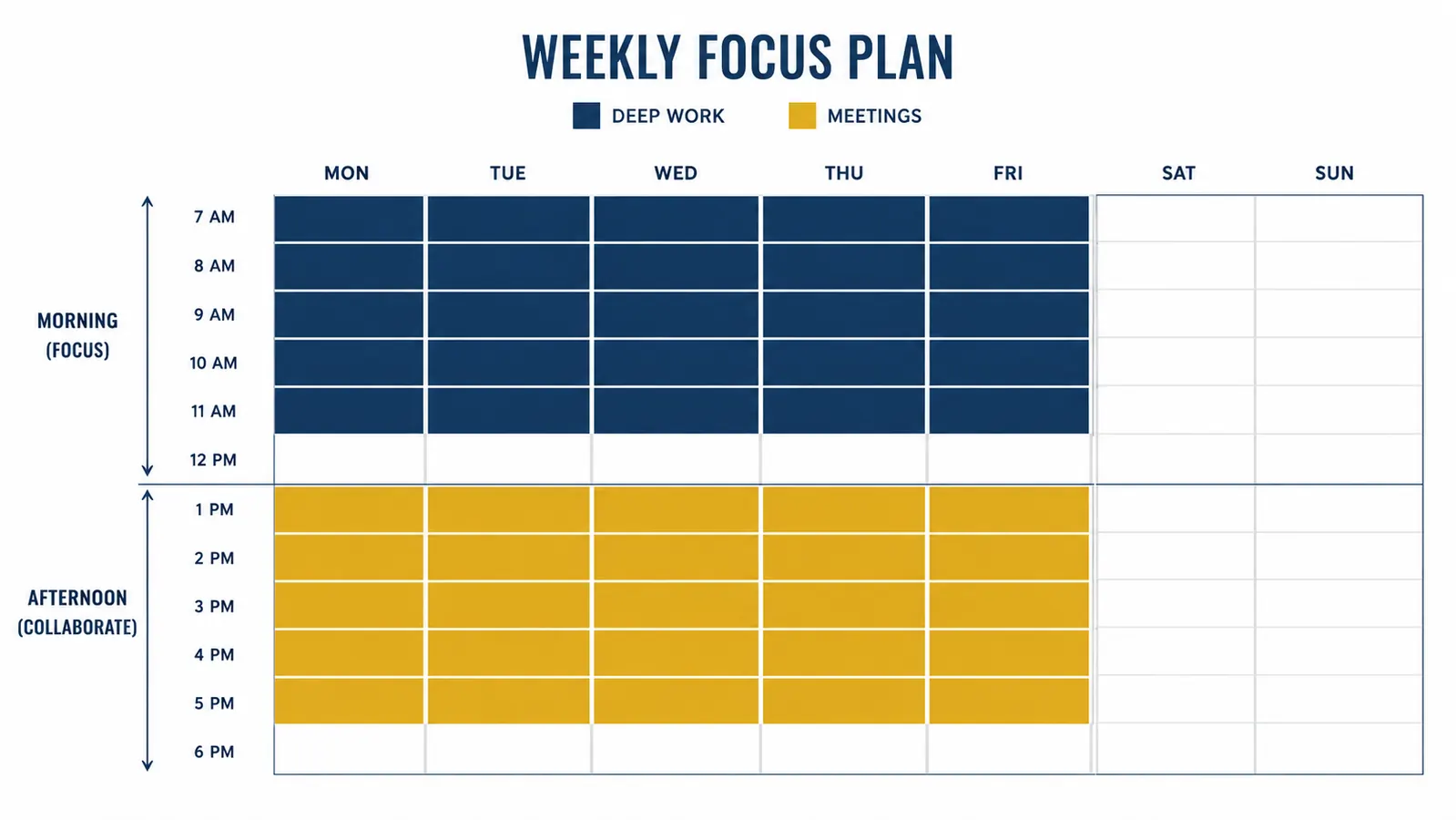
Meetings belong in the afternoons. If someone wants a morning meeting, the answer is no unless it is a paying client or a true emergency. Your morning deep work blocks are the only hours in the week where you are building rather than reacting. Protecting them is not about being precious. It is about recognizing that your best thinking happens before the day has had a chance to grind you down.
I protect three deep work mornings per week as non-negotiable. Tuesday, Wednesday, and Thursday before noon. Monday I keep lighter on purpose because the week is still settling. Friday is review and shutdown. That structure took me about three weeks to lock in and it is the single biggest output change I have made in the past two years.
Your best thinking happens before the day has had a chance to grind you down. Protect the morning or surrender it. There is no middle ground.
Step 4: Run a Two-Minute Daily Priority Check Every Morning
Every morning before you check anything else, open your planner to today's page. It takes 90 seconds. Read your three weekly outcomes at the top. Then write down the three things that must happen today to move at least one of those outcomes forward. These are your daily priorities. Everything else is optional.
The Anecdote planner has a dedicated Priorities section on each daily page, which is why this step is fast. You are not building structure from scratch every morning. The structure is already there. You are just filling in today's specifics. That distinction matters a lot at 7am when your brain is not fully online and you could easily drift into email instead.
Below your three priorities, use the Notes section to capture anything that comes up during the day that is not on the list. Do not stop what you are doing to chase those things. Write them down and stay on task. The discipline is not ignoring new information. The discipline is not letting new information hijack the plan you made when you were thinking clearly.

Step 5: Review Progress and Score Your Week Every Friday
Friday's shutdown is also your weekly score. Go back to Sunday's page and look at your three weekly outcomes. For each one, mark it as Complete, Partial, or Missed. If it is Partial or Missed, write one sentence about why. Not a guilt spiral, a diagnosis. 'Missed because a client crisis ate Tuesday morning' is useful data. 'Missed' with no context is just a loss.
Tracking your hit rate builds a feedback loop that most founders never bother with. After four weeks, you will know whether you are consistently setting outcomes that are too ambitious, whether a certain day of the week is reliably stolen, or whether one type of work always gets pushed. That data changes how you plan the next week. This is the difference between running on autopilot and actually getting better at running your business.
The Anecdote planner's Gratitude section on the daily page sounds soft but it serves a practical function here too. Writing three wins from the week, even small ones, recalibrates your signal-to-noise ratio. Founders who only track what went wrong burn out faster than founders who track the full picture.
What Else Helps This System Work
The planner is the anchor, but two other habits make the whole system more durable. First, keep a separate capture device during the day for anything that is not a current-week priority. I use a small index card clipped to the back of the planner. Everything that is not on today's priority list goes on the card. At Friday shutdown, I decide whether those items make it into next week's plan or get dropped entirely. Most of them get dropped. That is fine.
Second, keep your three weekly outcomes visible beyond just the Sunday page. I fold a sticky note with the three outcomes written on it and stick it inside the front cover of the planner. Every time I open the book I see them. This sounds trivial until you experience a Tuesday where you have been in back-to-back meetings since 9am, nothing on your list has moved, and you are about to send three low-priority emails just to feel productive. The sticky note is a pattern interrupt. It pulls you back to the actual plan.
If you want to go deeper on why a paper planner outperforms digital tools for this kind of planning, check out the breakdown in the article on 10 reasons a daily planner grows your business faster than any app. And if you are considering the Anecdote planner specifically and want to know how the format held up over 26 full weeks of business use, the long-term review covers the paper quality, durability, and layout in detail.
A planner that costs less than dinner and pays for itself in the first Monday it saves.
The Anecdote Daily Planner is undated, starts any week, and gives you one structured page per day for goals, priorities, and notes. At current price it is the lowest-cost productivity investment on this entire site. Pick it up, run this five-step system for 30 days, and compare your output to the month before.
Amazon Check Today's Price on Amazon →