
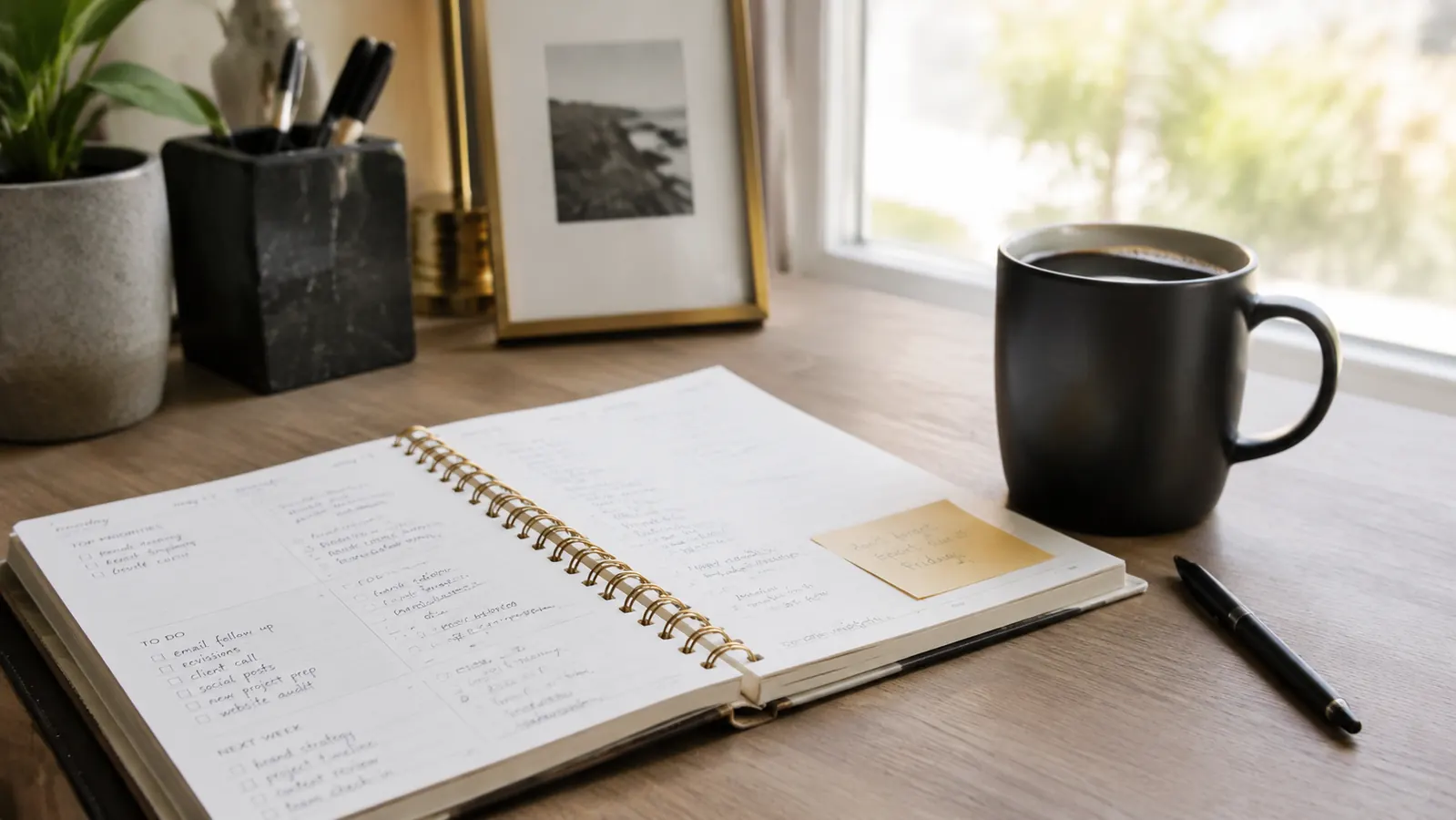
I have tried nearly every productivity app that has crossed my feed in the last five years. Notion, Todoist, ClickUp, Apple Reminders, a custom Airtable setup I spent two weekends building. They all had the same outcome: more time managing the system, less time running the business. Then I went back to paper, specifically the Anecdote Daily Planner, and the difference was immediate. I am not sentimental about tools. If it does not produce results, it gets cut. The planner earned its place.
If you are still toggling between four apps to organize your day, this list is worth your next four minutes.
Stop losing your best hours to a task manager you keep redesigning.
The Anecdote Daily Planner gives you one page for each day, a structured slot for your top three priorities, a goals section, and a gratitude prompt that keeps your head straight on hard days. Rated 4.4 stars by over 5,600 founders and professionals on Amazon.
Amazon Check Today's Price on Amazon →It forces you to choose your top three priorities before the day starts
Every app lets you pile in unlimited tasks. That is the problem. When everything is a priority, nothing is. The Anecdote planner has a dedicated slot for exactly three priorities per day. You physically cannot add a fourth without crossing something out. That constraint alone has saved me from chasing low-value work on dozens of mornings.
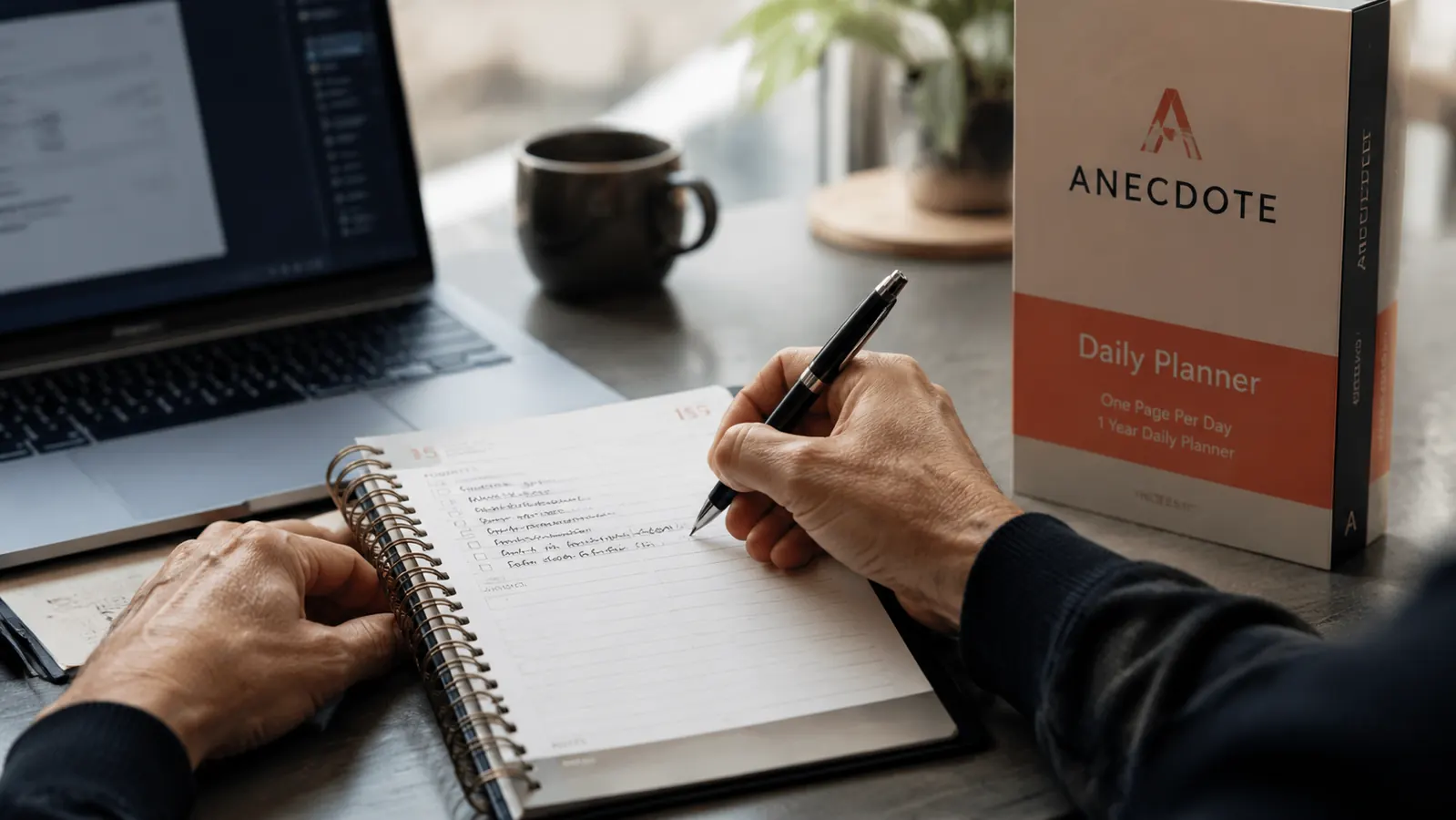
Writing by hand encodes your commitments more deeply than typing
Research from cognitive science is consistent on this: writing by hand activates deeper encoding than typing the same words. When you write your plan for the day, you are not just logging it. You are committing to it at a different level. I noticed that my follow-through on hand-written tasks is meaningfully higher than on anything I type into an app. The planner makes that a daily practice.
No notifications, no rabbit holes, no tab switches
Every time you open a productivity app, you are one notification away from checking email, Slack, or social media. The planner has no notifications. You open it, you plan, you close it, you work. That sounds simple. It is also genuinely rare in a workspace full of connected devices. I do my morning planning at my desk before I open my laptop, and those fifteen minutes are now the most uninterrupted planning time in my day.
The undated format means you never waste a Monday or lose your streak
The Anecdote planner is undated with 26 weeks of pages. You start on whatever day you buy it. If you travel for a week or take a break, you do not come back to a half-empty month staring at you. You just pick up the next blank page. For entrepreneurs whose schedules are irregular, this is a practical advantage most people overlook when comparing planners.
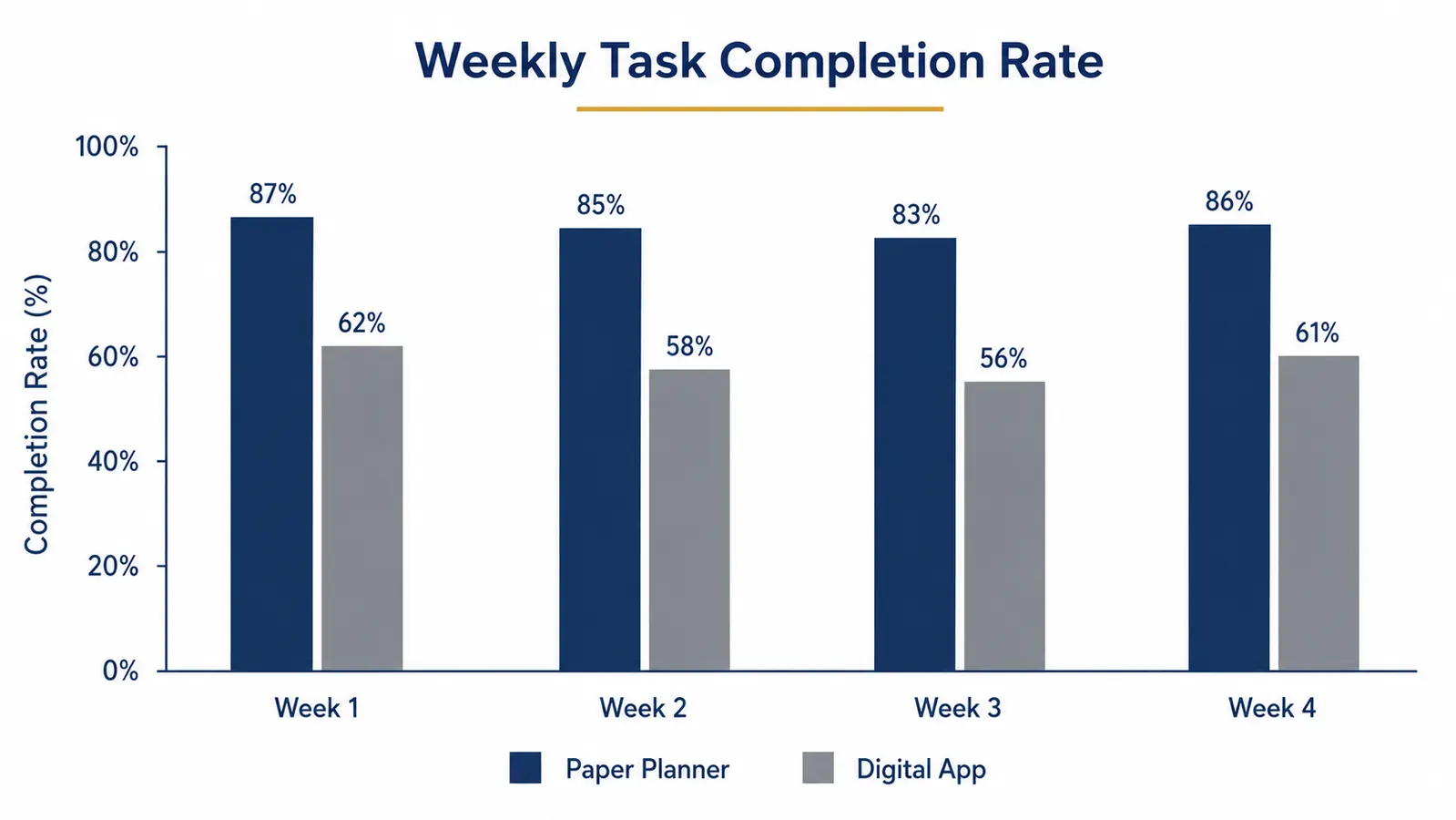
One page per day keeps your planning visible and your review fast
When I want to see what I accomplished last Tuesday, I flip to that page. There is no searching, no scrolling, no filtering by date. The one-page-per-day layout also means each day has a clear beginning and end, which is something apps struggle with. Your task list in most apps is a continuous scroll with no natural stopping point. The planner gives you closure at the end of every day.
The planner does not organize my tasks. It forces me to choose which tasks actually matter today. That is the job a budget notebook does better than a premium software subscription.
The built-in goals section keeps your 26-week direction in front of you daily
Most planners give you a goals page at the front that you fill in on day one and never look at again. The Anecdote planner integrates a goals reference into the daily structure. Looking at your longer-horizon goals every morning changes the type of priorities you write down. It is a small design decision that has a real compounding effect over a business quarter.
The gratitude prompt reduces decision fatigue by starting your day grounded
I used to skip gratitude prompts because they felt soft. I was wrong. Starting the day by writing one or two things that are actually working in the business is a fast way to reset your threat response before you open your inbox. Founders who are constantly in crisis mode make worse decisions. The daily gratitude prompt in the Anecdote planner is a thirty-second mental reset that I now treat as non-negotiable.

A physical planner creates an accountability artifact you can review with a team
Apps live in your phone or laptop. A planner sits on your desk. When I meet with my ops lead, I can flip through the last two weeks of pages in thirty seconds and give her an honest picture of where my time went. There is no export, no shared view, no login required. The physical record is honest in a way that a digital system you can edit retroactively is not.
The 2026-2027 calendar reference lets you schedule forward without opening your phone
The Anecdote planner includes a 2026-2027 calendar at the front. When someone asks if I am available in October, I open the planner, check the calendar, and answer. I do not hand over my phone, unlock it, switch apps, and then try to make eye contact again. Small friction savings like this add up to meaningful time recovered across a full week of meetings.
At this price point, the ROI calculation is not worth arguing about
The Anecdote Daily Planner costs less than a single hour of your own billable time. If using it recovers even thirty minutes of wasted planning time per week, it has paid for itself in the first month. Over 5,600 reviewers on Amazon have given it 4.4 stars. The complaints are almost entirely about personal preference on line thickness or paper color. The core system works. At this price, the risk of trying it is essentially zero.
What I Would Skip
If you need deep calendar blocking, project management across a team, or recurring task automation, a planner is not the right tool. The Anecdote does not replace a project management platform. It replaces the part of your morning where you stare at a screen trying to decide what to do first. If your problem is execution and focus, it will help. If your problem is coordination across ten people, you need software. Use the right tool for the right job.
I also would not recommend it if you refuse to sit down for fifteen minutes every morning before your day starts. The planner requires a planning habit. It does not create one for you. If you are already consistent with a morning routine, the Anecdote slots in cleanly. If you are not, start there first. For a deeper look at how to build a full weekly planning system around this planner, see my guide on how to plan your business week for maximum output. And if you want the full six-month breakdown before you buy, the long-term review of the Anecdote Daily Planner covers everything.
Apps are good at storing information. Paper is good at driving decisions. Know which problem you are solving.
If your mornings feel scattered and your priority list never shrinks, the fix might be a budget notebook.
The Anecdote Daily Planner is undated, one page per day, with a structured layout for priorities, goals, and daily reflection. Over 5,600 founders and professionals rated it 4.4 stars. No subscription, no app, no setup. Just open it and plan.
Amazon Check Today's Price on Amazon →