
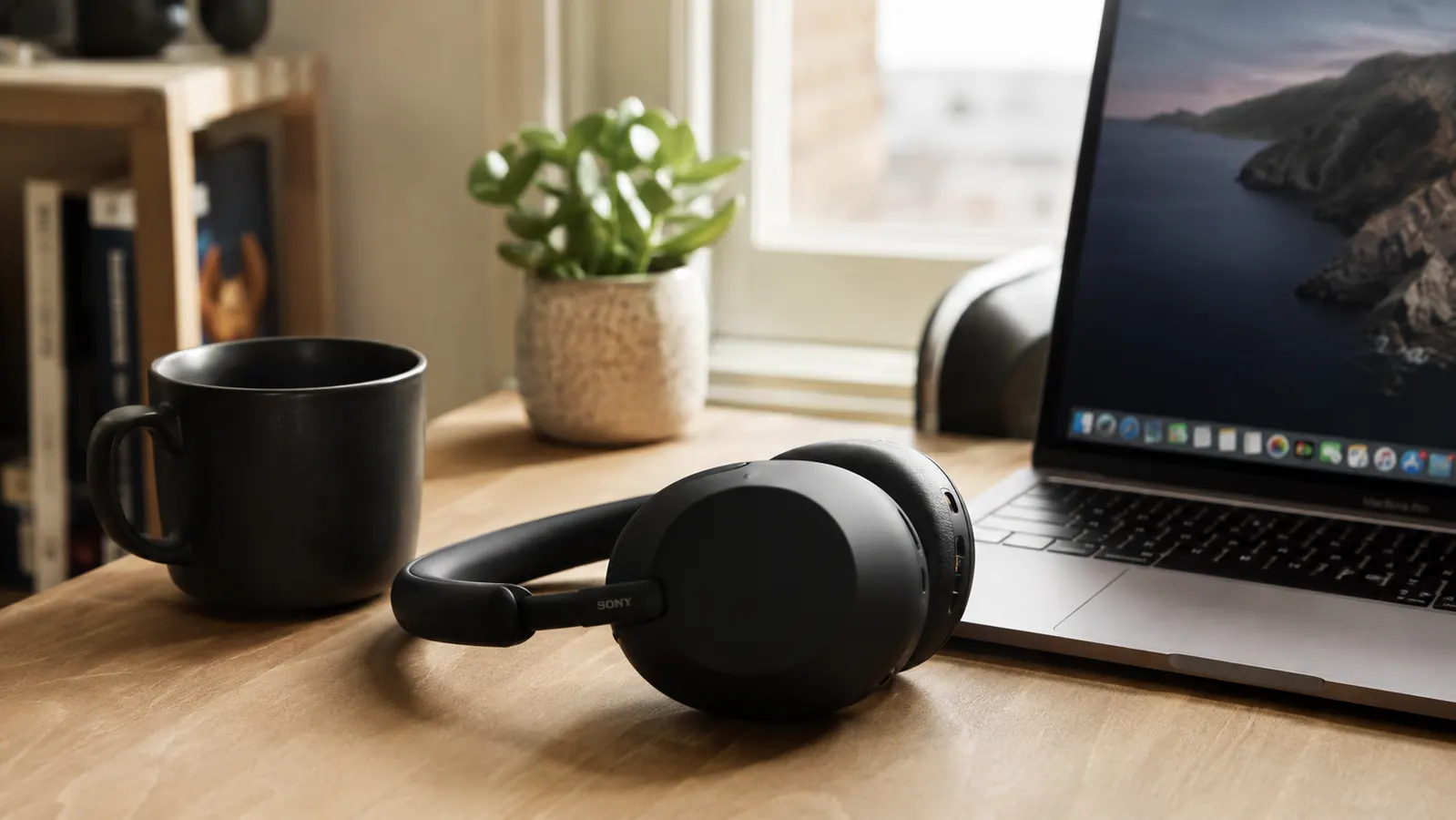
Six months ago I was losing two to three hours every workday to noise. Not catastrophic noise. Just the slow bleed of a HVAC crew two houses down, my teenager's music bleeding through the wall, and the neighbor who inexplicably runs a leaf blower on Tuesday mornings. I run a services business from a home office, and every interruption cost me real money in rescheduled calls and restarted writing sessions. I bought the Sony WH-1000XM5 expecting incremental improvement. What I got was a structural change in how my workdays run.
I have been wearing these headphones almost every workday since January. I am not a gear reviewer by trade. I am a business operator who needed a tool to work, and I want to tell you exactly what working with the WH-1000XM5 looks like at the six-month mark, not at unboxing.
The Quick Verdict
The best noise cancellation in any headphone I have tested, with call quality and battery life that hold up in real founder workdays. The carrying case is flimsy for the price and the fit can fatigue after four hours. Still the one I reach for every morning.
Amazon Check Today's Price →Stop losing hours to background noise. Check today's price on the WH-1000XM5.
Over 19,000 Amazon reviews. 4.2 stars. 30-hour battery. The noise cancellation that finally let me stop working in my car just to get quiet.
Amazon Check Today's Price on Amazon →How I Have Used It
My workday starts around 7:30 AM and runs to 6 PM with a loose lunch break. I wear the WH-1000XM5 in roughly three-hour blocks. Mornings are deep work: writing, proposals, financial modeling. Afternoons are calls, anywhere from two to six a day depending on the week. I use the headphones for all of it. That means the microphone gets real stress, not just a quick Zoom test.
I travel once or twice a month for client work. The WH-1000XM5 goes in my carry-on every time. I have worn them on flights from Orlando to Denver and Seattle, in rental cars, in hotel lobbies, and once in a remarkably loud conference center hallway where I had to take a 45-minute call while waiting for a room. They handled all of it. I have also worn them mowing the lawn when I am on hold with a vendor, which I recognize is a bit much, but the point is they get used hard.
For reference on what six months of real use looks like physically: the earcup padding has a slight compression on the left side where it rests against my glasses arm. The headband shows light wear marks. The USB-C port still clicks in firmly. No cracks, no software instability. They look like a tool that has been used, not like a broken one.
Noise Cancellation: The Thing It Actually Does Better Than Anything Else
Let me be specific about what the WH-1000XM5 blocks and what it does not. The Auto NC Optimizer calibrates to your environment when you first put the headphones on. In practice, this means constant low-frequency noise, AC units, traffic, HVAC hum, power tools at a distance, essentially disappears. The leaf blower two houses over becomes a very faint texture, not a sound. If you have never experienced this level of ANC, it feels a little uncanny the first time.
What it does not fully eliminate: voices in the same room. If someone is standing four feet away talking at normal volume, you will hear a muffled version of that. It also does not kill sharp transient sounds like a dropped pan in the kitchen. But for the continuous-noise problem that kills focus work, the WH-1000XM5 is genuinely the best I have tested at this price. I have used Bose QC45s for two years before this. The Sony is a level better on ANC in steady-state noise environments.
One thing I did not expect: the ANC also reduces the cognitive load of being ready to hear something. You know that low-level alertness you carry when you are in a noisy environment? Working with good ANC on eliminates it. I do not have a study for this. I just know I end the day feeling less wrung out.
Call Quality: What Your Clients Actually Hear
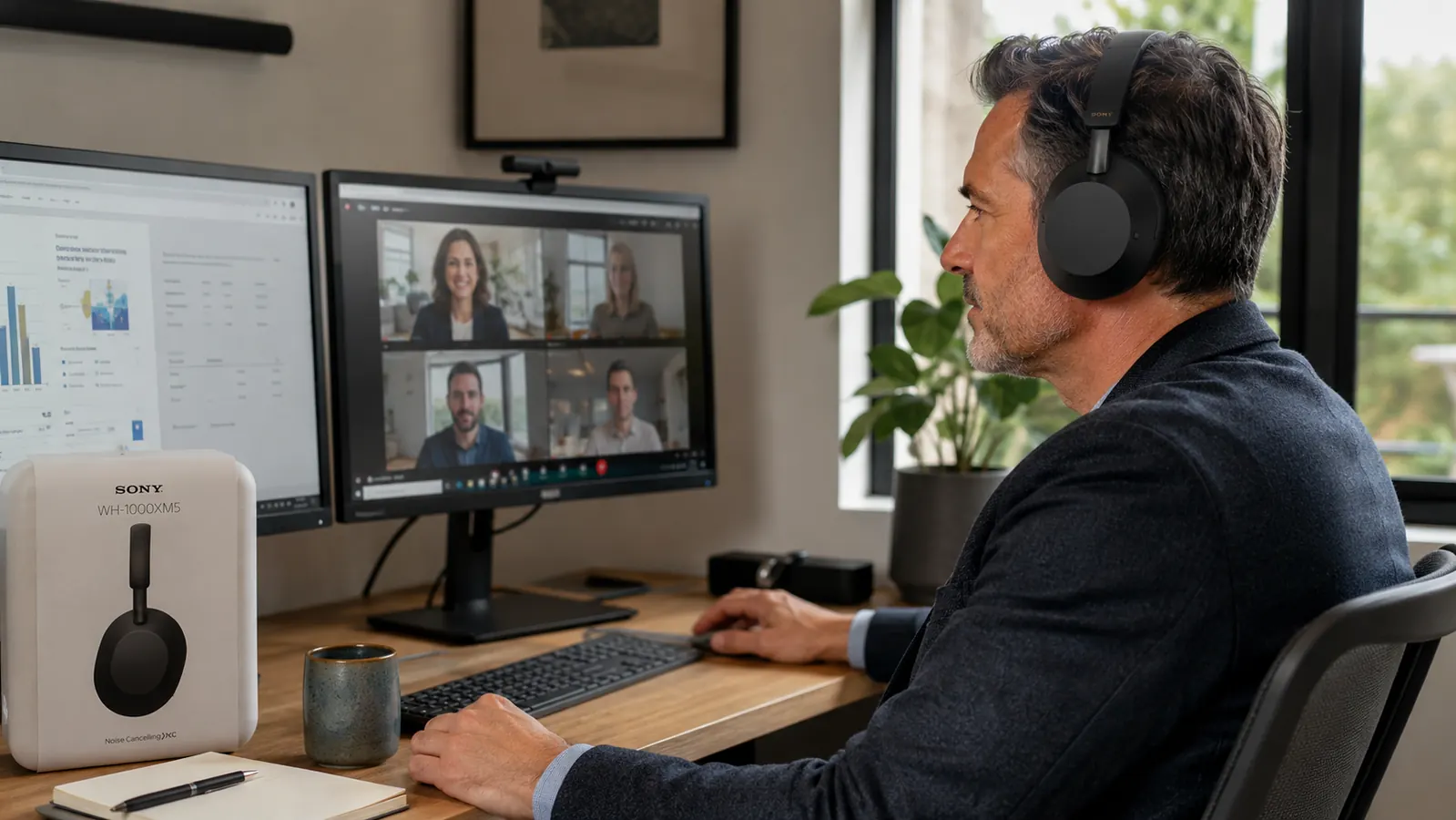
The WH-1000XM5 has eight microphones for call pickup. Sony calls it an AI-based noise suppression system. What my clients actually notice is that they do not ask me to repeat myself, they do not mention background noise, and nobody has ever told me I sound like I am on a headset. That last one matters. The audio is clear and natural, not the slightly hollow, over-processed sound you get from some noise-suppressing earbuds.
I ran a test in January that I still think about. I set up a call while my HVAC was running, my teenager was doing schoolwork in the next room, and I had a small fan on my desk. I asked the person on the other end to give me honest feedback on what she heard. She said she could hear me clearly and had no idea there was noise in the room. That is the output that matters for a client-facing business.
My clients do not hear the leaf blower, the HVAC, or the teenager. After six months, that alone has paid for these headphones in recovered call quality and credibility.
One honest callout: call quality does drop if you use the headphones in simultaneous streaming mode while on a call. The Bluetooth codec shifts and the latency goes up slightly. I keep call audio exclusive, meaning I am not playing music and on a call at the same time. That works perfectly. If you need both simultaneously, test your setup before relying on it for client calls.
Battery Life at Six Months: Still Honest
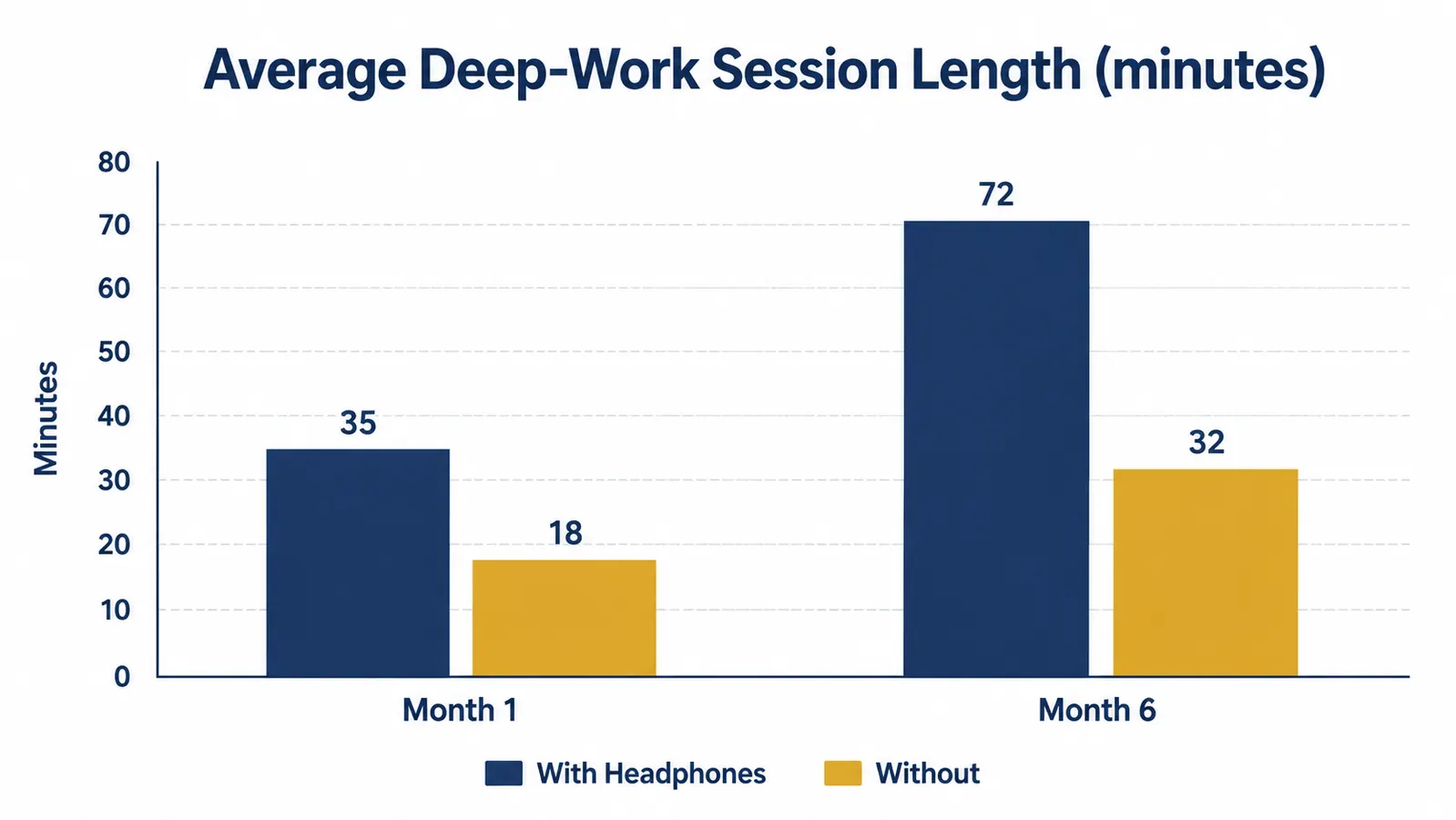
Sony rates the WH-1000XM5 at 30 hours with ANC on. At the six-month mark I am getting what feels like 26 to 28 hours. I charge roughly every three days. I have never run them to zero in the middle of a workday, which says something given my usage pattern. The quick-charge feature delivers three hours of play from a three-minute charge. I have used this exactly twice, both times before a flight when I forgot to charge the night before. It worked both times.
Battery degradation in Bluetooth headphones is real over time. Six months is not long enough to say definitively whether the WH-1000XM5 holds up at the two or three-year mark. What I can say is that at six months there is no noticeable drop from spec. I will update this if that changes.
Comfort Over Long Sessions: The Honest Limitation
For sessions under three hours, the WH-1000XM5 is comfortable. The earcups are soft, the clamping pressure is moderate, and the headband padding distributes weight reasonably. I wear glasses and the left earcup does press on the arm of my frames. After about 90 minutes I shift the headphones slightly. By the four-hour mark I take them off for ten minutes.
If your workday involves six-plus hour sessions with headphones on continuously, this may be a real friction point. I have read forum posts from users with larger heads who find the clamping force too high after sustained wear. I have a medium head, wear glasses, and find them acceptable but not effortless after four hours. This is the one area where I think Sony made a trade-off that favors the lighter, sleeker industrial design over maximum long-session comfort.
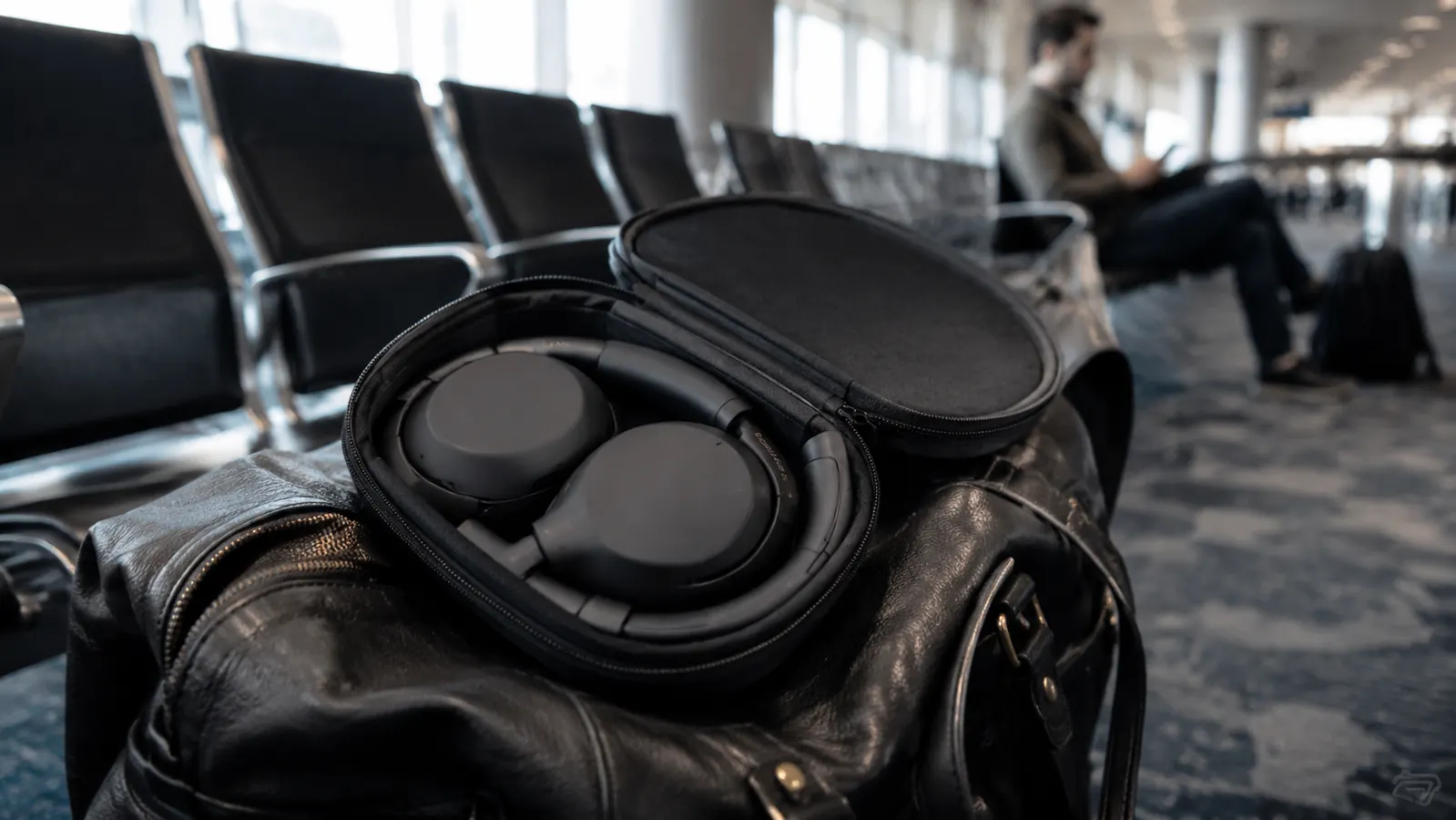
The WH-1000XM5 also does not fold flat the way the XM4 did. The earcups rotate but the headphones stay in a kind of open position. The carry case accommodates this but it is bigger than I expected for something I am putting in a laptop bag. Not a dealbreaker, but worth knowing.
What I Liked
- Best-in-class ANC for steady-state background noise, including HVAC, traffic, and power tools
- Microphone quality is genuinely good for client-facing calls, not just passable
- 30-hour battery in practice lands at 26 to 28 hours at six months, well above average
- Quick Charge delivers usable battery in three minutes flat
- Multipoint Bluetooth connects to two devices simultaneously, which matters if you switch between phone and laptop
- Speak-to-Chat feature pauses audio when you talk without touching the headphones
Where It Falls Short
- Comfort degrades past four hours of continuous wear, especially with glasses
- Does not fold flat like the XM4, which makes packing slightly more awkward
- Carry case feels thin relative to the headphone price
- ANC does not fully eliminate voices in the same room, only continuous background noise
- Sony Headphones Connect app adds features but adds bugs too; occasional Bluetooth reconnect delays on macOS
Who This Is For
The WH-1000XM5 is built for people who do high-value knowledge work in noisy or unpredictable environments and cannot afford to let noise interrupt it. That is most founders working from home, most professionals on client calls from shared spaces, and most people who travel for business regularly. If you take three or more calls a day and need the person on the other end to trust that you are in a controlled professional environment, these headphones remove the variable. If you do deep work that requires sustained focus and your environment is not fully controllable, the ANC is the best tool I have found for managing it.
Who Should Skip It
If your primary use is music listening in a quiet environment, you are paying for ANC capability you do not need. There are better-sounding headphones at a lower price for pure audio. If you wear headphones for five or more continuous hours and have a larger head or wear thick-frame glasses, the comfort issue may outweigh the benefits. If the carry case and non-folding design genuinely limit portability for your travel setup, it is worth testing in a store first. And if Bluetooth reliability on macOS is a hard requirement with no tolerance for occasional reconnect issues, test it against your specific machine before committing.
For the majority of working founders and professionals I have talked to, none of those exceptions apply. The WH-1000XM5 earns its spot in a professional toolkit the same way a good standing desk or a fast laptop does. It pays for itself in recovered productivity.
If noise is costing you focus time, the WH-1000XM5 is the tool that fixes it.
Six months of daily founder use. Proven on calls, deep work, travel, and contractor mornings. Check today's price on Amazon and see current availability.
Amazon Check Today's Price on Amazon →