
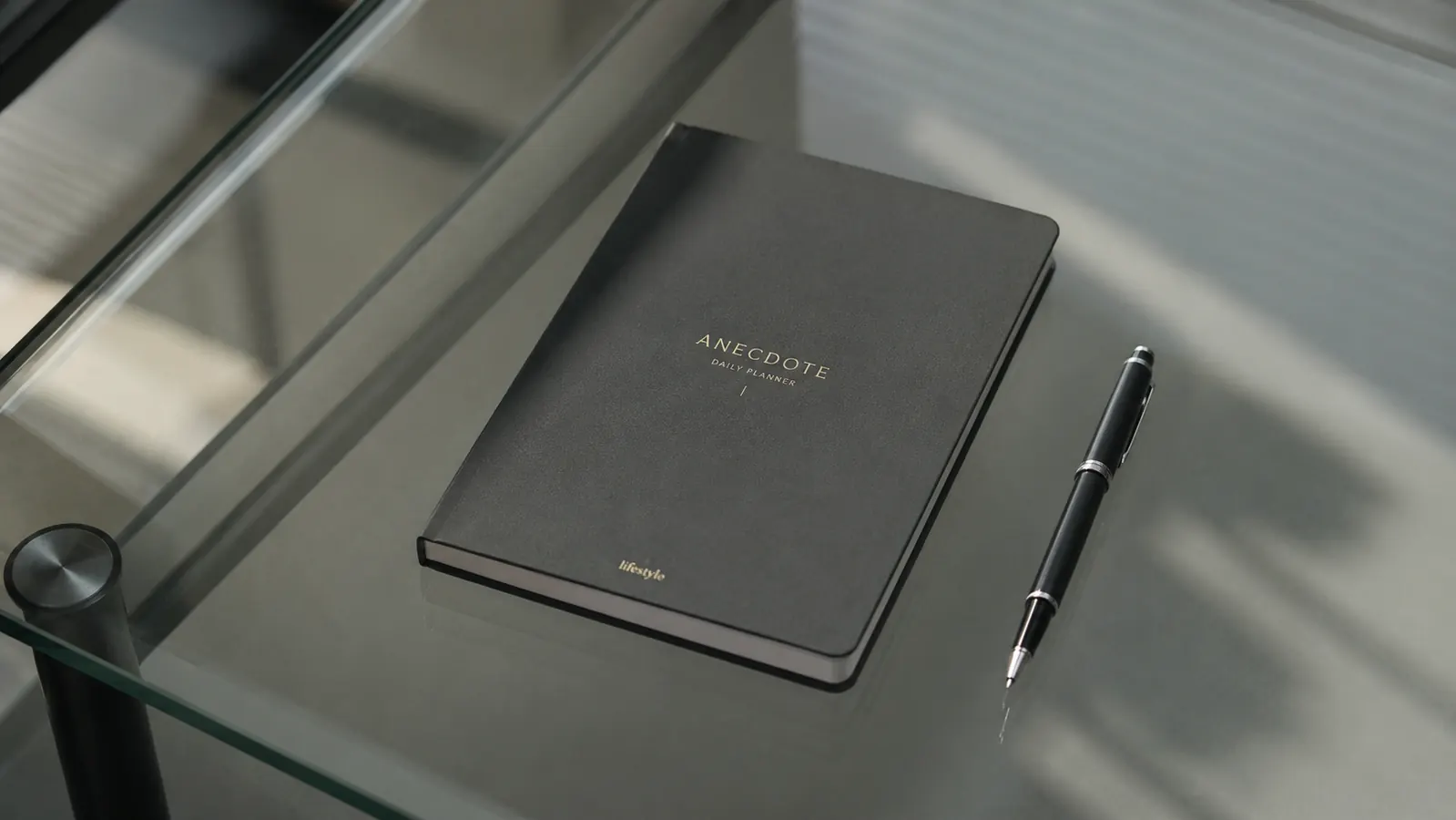
Let me tell you what the 4.4-star rating on the Anecdote Daily Planner does not tell you. It does not tell you about the binding behavior after month three. It does not tell you that the gratitude prompts will quietly annoy a certain kind of operator every single day. And it does not tell you that there is one structural omission in the layout that will hit you hard if you manage a calendar with more than four recurring meetings per week. I used this planner for a full 26-week business cycle, and I am going to give you the version of this review that most buyers wish they had read before they ordered.
I am Marcus. I have operated businesses across service, product, and consulting sectors. I have been in rooms where planners were debated like theology, and I have also thrown planners in a drawer after two weeks because the system asked more of me than it gave back. The Anecdote is not that. But it is also not perfect, and the places where it falls short are specific enough that some people should not buy it at all.
The Quick Verdict
The Anecdote Daily Planner earns its price for solo operators who want a daily forcing function without a coaching framework bolted on, but the binding warps under heavy use and the layout leaves calendar managers underserved.
Amazon Check Today's Price →If you are running your day off sticky notes and a browser full of tabs, a budget planner with 5,600 reviews will outperform both.
The Anecdote Daily Planner is undated, starts any Monday, and covers 26 weeks of daily planning. Current price and availability are on Amazon now.
Amazon Check Today's Price on Amazon →The One Real Drawback Nobody Talks About
Here is the thing the positive reviews skip: by week 14 or 15, the Anecdote's binding starts to cup. The book no longer lies flat on the desk when open. The pages bow slightly toward the spine. If you write across the full width of the daily page, you will feel the resistance near the center gutter and your handwriting will start to drift upward on the left page. This is not catastrophic, and it did not stop me from finishing the full 26 weeks. But it is a real physical degradation that accumulates over the second half of the planner's life.
This matters more than it sounds because the Anecdote's layout depends on writing. The three priority slots and the notes section require you to write legibly every morning for six months. When the book stops lying flat, the physical act of writing becomes slightly more effortful on days when you are already fighting friction to sit down and plan. It is a small thing that compounds into an irritant. A heavier board cover or a lay-flat PUR binding would fix it. At the current price, you are accepting the tradeoff. I want you to know that going in.
What the Layout Gets Right That Most Planners Get Wrong
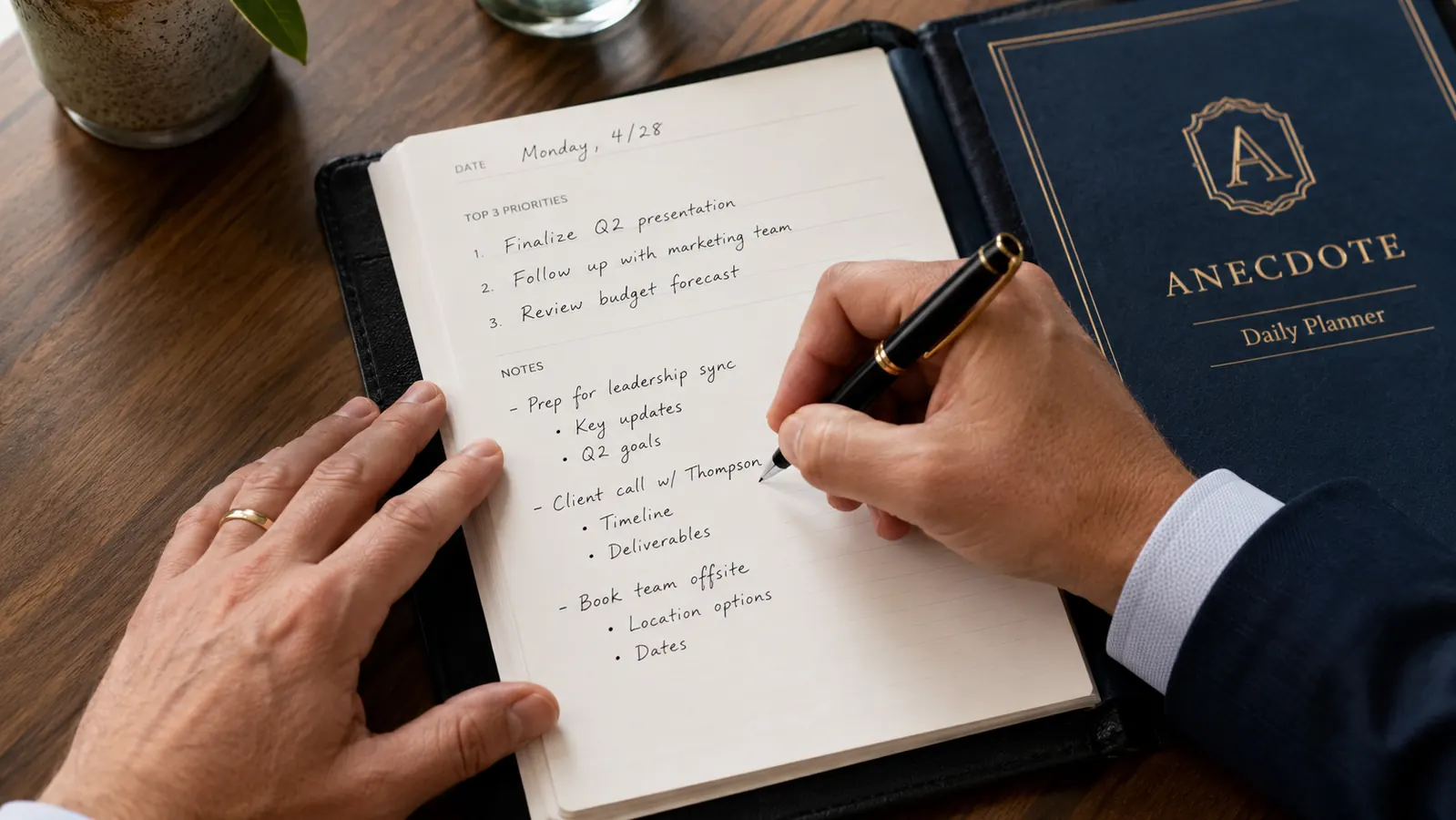
Most daily planners give you a blank task list or a time-grid and leave you to figure out prioritization yourself. The problem with a blank task list is that everything on it feels equally important until you miss a deadline and realize it wasn't. The Anecdote's three-slot structure at the top of each daily page solves this by making prioritization a visible physical act, not a mental one you do implicitly.
Slot 1. Slot 2. Slot 3. That is all you get at the top. If you have twelve things to do today, you are forced to decide which three go there. Everything else gets listed in the notes section below, which creates a natural two-tier system: what you are committing to finishing today versus what is on your radar. Founders who have spent years fighting a to-do list that never shrinks will recognize immediately what this constraint does. It does not eliminate the long list. It tells you what to touch first, and that changes the output of your morning in a measurable way.
The quarterly goal pages at the front of the book work in conjunction with this. You set your primary goal and two supporting goals at the start of the 26 weeks, and those goals sit at the front of the book every day you open it. The intention is that your daily top-three connects to those quarterly anchors. In practice, the connection is not automated or prompted on the daily page itself. It relies on your own memory and discipline. But having the goals physically present in the same object you use every day is more effective than having them in a spreadsheet that you last opened six weeks ago.
The Paper Quality: Better Than the Price Implies, With One Caveat
The paper in the Anecdote is one of its genuine strengths. It is noticeably thicker than what you find in comparably priced planners from generic brands. I write primarily with a Zebra F-701 ballpoint and a Pentel EnerGel 0.5mm rollerball, and I had no bleed-through on any page across the full 26 weeks. Ink sits on the surface cleanly, dries fast, and the lines are spaced at a width that works for normal adult handwriting without feeling cramped.
The caveat: fountain pen users will see ghosting on heavyweight inks. I tested a TWSBI Eco with Iroshizuku ink for one week and the show-through on the reverse side was noticeable, though it never bled completely through. If your primary writing instrument is a fountain pen, the Anecdote's paper is borderline acceptable, not excellent. For every other pen type, it is genuinely good.
The matte cover texture holds up physically but picks up minor scuffs over months of desk use and bag transport. After 26 weeks, the corners of my copy showed light wear. Nothing structural failed. The cover is a practical surface, not a luxury one, and it performs exactly at that level.
Most planners give you a blank list and call it structure. The Anecdote gives you three slots and forces a decision. That difference is worth more than the price.
Who Gets Frustrated with This Planner: Be Honest with Yourself
There is a specific type of operator who will bounce off the Anecdote within four weeks, and it is worth naming them directly. If you manage five or more meetings per day and you need to see your calendar alongside your task list, the Anecdote will feel incomplete. The daily page has no time grid, no hour blocks, no morning-to-evening visual representation of your schedule. It is a prioritization and notes tool, not a calendar replacement. Using it alongside a digital calendar works fine. Trying to make it your only scheduling surface does not.
The gratitude prompt at the bottom of each daily page is small but present. It is one line. Most people I have shown the planner to react to it the same way: they either ignore it completely, or it adds a mild irritant every time they reach the bottom of the page. If you are a systems operator who sees no business value in a daily gratitude practice, that prompt will feel like padding. It will not stop you from using the planner, but you will notice it every day in a way that slightly reduces your affection for the product.
The daily win box has the same dynamic. For solo founders who are also their own accountability partner, writing a daily win has real value: it interrupts the habit of moving immediately from done to the next task without acknowledging progress. But for founders who find this kind of self-reflection performative, both the gratitude and win boxes will sit blank every day and feel like wasted real estate. Anecdote clearly designed for a reader who values both the operational and the reflective. If you are purely operational, you will use roughly 75 percent of each page and feel mildly taxed by the other 25.
The 2026-2027 Calendar Section: Useful or Decorative?
The current version of the Anecdote includes a 2026-2027 two-page monthly calendar spread at the front, before the daily pages begin. It shows the full year in a mini grid format that you can use for marking major milestones, deadlines, or project phases. I used it to mark two client contract milestones and three travel windows. It served its purpose as a year-view reference without requiring any ongoing maintenance.
What it is not is a month-by-month detailed calendar. There is one row per week and small boxes per day. You can write one or two words in each box at most. Do not expect to manage your April schedule from that page. It is an orientation tool, and it functions well as exactly that. Founders who need to see a month at a time in detail will need a separate calendar tool regardless of which planner they use.
Durability Over 26 Weeks: The Honest Accounting
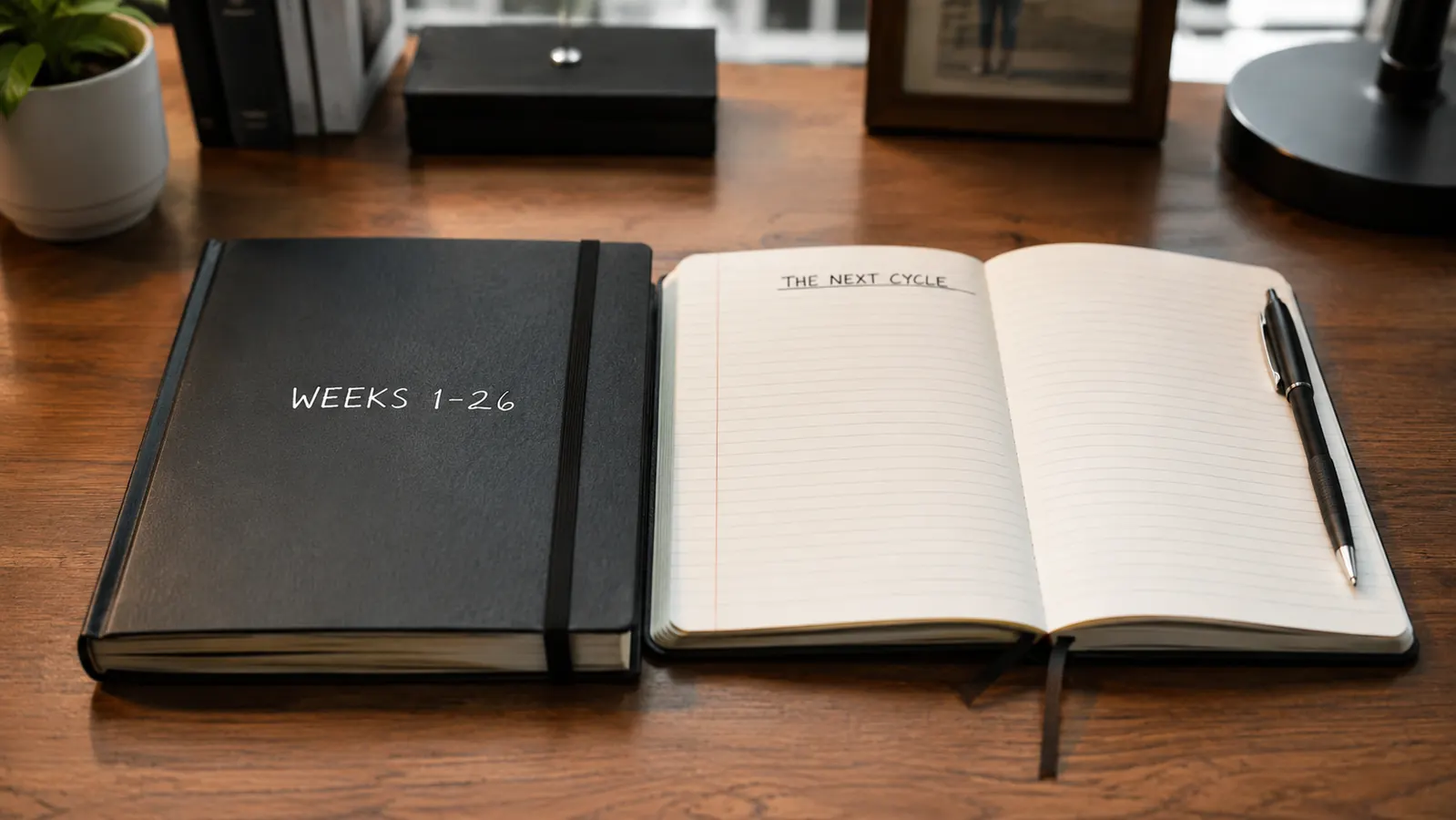
I want to give you a concrete durability report because most reviews are written by people who used a planner for three weeks and called it done. After 26 weeks of daily use, here is the actual condition of my Anecdote: spine intact, no page separation, no pages torn loose at the binding. Cover shows light surface scuffs on the corners and back face. The binding cup I mentioned earlier developed around week 14 and is present but stable. No further degradation between week 14 and week 26. The book did not fall apart. It aged.
I transported it in a backpack daily during a two-week stretch and in a roller carry-on for one business trip. No damage from compression or travel. The soft-touch matte finish picks up oils from hands over time and shows fingerprints under direct light, which is purely cosmetic. I use this detail not to be pedantic but because people considering a premium-feeling planner versus a practical one should know: the Anecdote is practical. It will look used after six months because you used it. That is a feature, not a flaw, if you think about it correctly.

How the Anecdote Compares to What You Are Probably Already Using
Most entrepreneurs who consider buying the Anecdote are coming from one of three places: a digital-only system that is not working, a previous planner that they stopped using, or a scattershot combination of notebooks and apps with no single source of truth for the day. The Anecdote addresses all three origin stories, but in different ways.
If you are coming from a digital-only system, the friction of switching to paper is real for the first two weeks. Muscle memory pulls you toward your phone. The benefit is that the physical act of writing priorities by hand creates a different kind of cognitive commitment than typing them into Notion or Todoist. Research on this is solid. Writing by hand encodes information differently and the act of choosing three things to write down forces a clarity that clicking checkboxes does not. After week two, the friction disappears for most people.
If you are coming from a previous planner that you abandoned, the honest question is whether you abandoned it because the system was wrong or because the habit was not yet built. The Anecdote will not build the habit for you. It makes the habit easier to maintain once you have decided to have it. If you are looking for a planner that will automatically make you more disciplined, that product does not exist. What the Anecdote does is make the daily prioritization ritual as low-friction and as clear as possible once you sit down to do it.
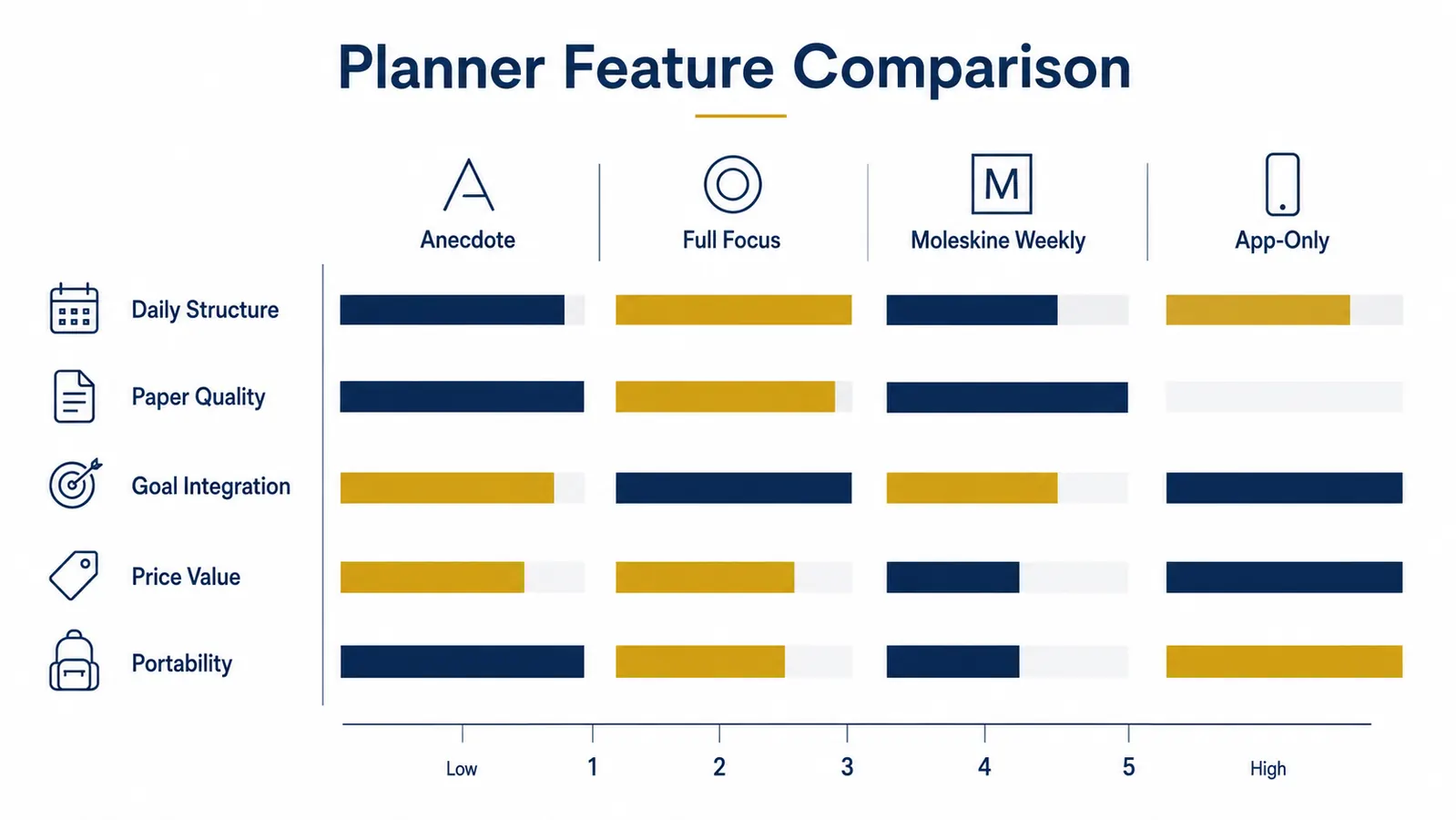
For a deeper head-to-head comparison of how the Anecdote stacks up against the Full Focus Planner across price, structure depth, and daily usability, the full breakdown is at Anecdote Daily Planner vs Full Focus Planner: Which Is Better for Entrepreneurs. And if you want the long-term use story from a full half-year of daily business operations, that is covered at Anecdote Daily Planner Review: 26 Weeks of Running a Business from One Notebook.
What I Liked
- Three-slot daily prioritization forces real decisions instead of wishlist-style task dumps
- Paper quality handles ballpoint and rollerball without any bleed-through across a full 26-week run
- Undated format means no wasted pages if you skip days or start mid-year
- 26-week arc maps cleanly to a half-year goal cycle for entrepreneurs already thinking in quarters
- Compact enough to carry daily without adding meaningful weight to a bag
- Current price puts it well below comparable structured planners like Full Focus or Panda Planner
Where It Falls Short
- Binding cups noticeably by week 14-15 and does not lie flat for wide-page writing in the second half
- No hourly time grid means it cannot serve as a calendar replacement for founders with dense meeting schedules
- Gratitude and daily win prompts feel like friction to purely operational users who have no interest in reflective journaling
- Single ribbon bookmark makes it inconvenient to keep both the quarterly goal section and the current daily page accessible at the same time
- Fountain pen users will see ghosting on heavyweight inks, limiting ink choice for serious pen users
Who This Is For
The Anecdote Daily Planner is built for the founder or professional who wants one daily decision-making ritual and no coaching framework attached to it. If your primary planning problem is that you start every morning with twenty things on your mental list and no clear ordering of them, this planner solves that problem as cleanly as anything I have tested at any price. Solo consultants, independent service providers, early-stage founders, and ambitious corporate professionals who manage their own execution within a larger organization will all find the layout functional and the price easy to justify. The 26-week run is long enough to track meaningful business progress without feeling like you are committing to a subscription.
Who Should Skip It
Skip the Anecdote if you need an hourly calendar built into your daily page. Skip it if you are a fountain pen user who is particular about ink and paper performance, because the paper is good but not excellent for heavyweight fountain pen inks. Skip it if the binding cupping will bother you in months four through six, because it will happen and it is not fixable. And skip it if you find reflective prompts like gratitude and daily wins demotivating rather than useful, because the layout assumes you want both the operational and the personal-growth elements. If you want a planner stripped down to pure task management with zero journaling DNA, look at something like the Panda Planner Pro or a custom Leuchtturm1917 setup instead.
If your mornings are running you instead of the other way around, the fix starts with a single page and three blank numbered slots.
The Anecdote Daily Planner has 4.4 stars from over 5,600 Amazon reviewers. It is undated, covers 26 weeks, and costs less than most business lunches. Check the current price before you decide.
Amazon Check Today's Price on Amazon →